Case Study: Oxford Brookes University and Erda Energy – From Ground-Source Heat Pumps to Dynamic Geo-Exchange
Oxford Brookes University (OBU) partnered with Erda Energy and Black Mountain Renewables to modernise its heating infrastructure and support its commitment to achieving net zero. Following the university’s declaration of a climate emergency in 2021, the project focused on reducing reliance on natural gas through an innovative geo-exchange heating and cooling system at the John Henry Brookes (JHBB) building on its Headington campus.
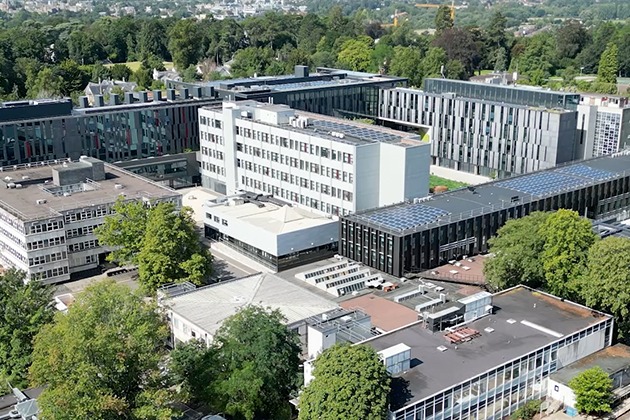
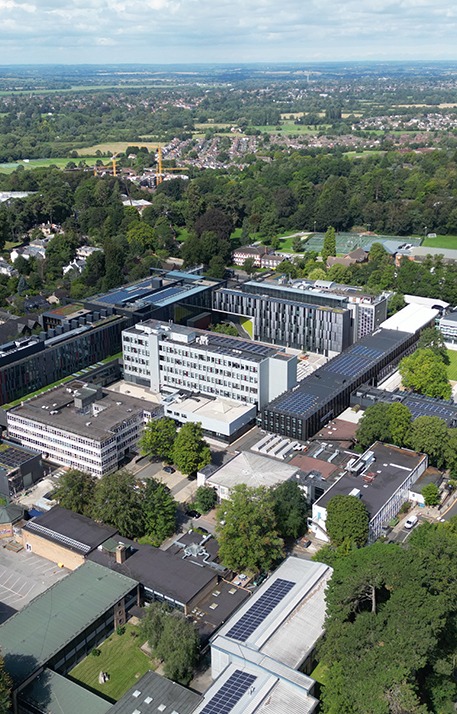
The project presented several challenges due to the university’s compact urban environment. Limited available ground space, rooftops prioritised for solar panels and the presence of existing gas boilers and combined heat and power (CHP) systems made conventional renewable heating solutions difficult to implement. Additionally, installation work had to take place near a busy bus route and car park without significantly disrupting university operations.
To overcome these challenges, Erda Energy designed a geo-exchange system using 14 inclined Erda| deep (ED) boreholes, drilled to a depth of 220 metres, alongside two high-efficiency heat pumps with a combined thermal capacity of 250 kW. Unlike conventional ground-source heat pump systems, Erda’s technology uses inclined drilling and advanced coaxial boreholes to maximise heat exchange while minimising the surface area required. This meant the entire installation occupied just 0.05 acres (2,178 square feet), making it particularly suitable for a space-constrained urban campus.
Another important feature of the project was the integration of smart monitoring and control technology. Through Erda’s system, more than 200 performance variables, including ground temperatures, flow rates, energy consumption and heat pump efficiency, are monitored in near real time. A 10-year energy performance and optimisation contract ensures the system is continuously monitored and adjusted to maintain efficiency and identify potential problems early. The system was also integrated with OBU’s existing heating infrastructure, allowing the university to retain its gas boilers and CHP equipment to meet higher-temperature heating requirements.
Installation was completed over 22 weeks during the winter period, with minimal disruption to university activities. Pedestrian and vehicle access remained operational, and the installation was largely invisible once completed, with only small manhole covers visible in the roadway.
The results have been significant. Since becoming operational, the system has reduced gas consumption for heating in the JHBB by 53%. This has contributed to a 63% reduction in the university’s Scope 1 and 2 emissions against its 2010 baseline, putting Oxford Brookes ahead of schedule towards its target of a 68% reduction by 2030. The system has also improved local air quality by reducing nitrogen oxide emissions.
The project is now progressing into Phase 2, which involves installing two additional heat pumps, upgrading equipment and extending heating and cooling provision to multiple university buildings. Importantly, this expansion will not require additional ED boreholes. The system is expected to more than double its total output to 3.5 GWh, while introducing more efficient cooling through the use of the ground as a seasonal thermal energy storage system.
Over its projected 25-year lifecycle, the completed system is expected to deliver a 16–23% reduction in energy consumption and operating expenditure compared with a gas alternative, alongside a 92% reduction in lifecycle carbon emissions.
Overall, the Oxford Brookes University project demonstrates how innovative geothermal technology, combined with smart monitoring and ongoing optimisation, can provide an effective low-carbon alternative to conventional heating systems. It highlights the potential for universities and other organisations to decarbonise existing buildings, overcome space constraints and reduce operational costs while improving energy efficiency. The case study also demonstrates that successful decarbonisation requires more than simply installing renewable technology; continuous monitoring, effective integration with existing infrastructure and long-term system management are essential to achieving lasting performance improvements.
To read the full case study, see link below.