Bigger Isn’t Always Better: Rethinking Geothermal Borehole Design
In many industries, “bigger” is seen as better. But in geothermal energy, more infrastructure does not always mean better performance.
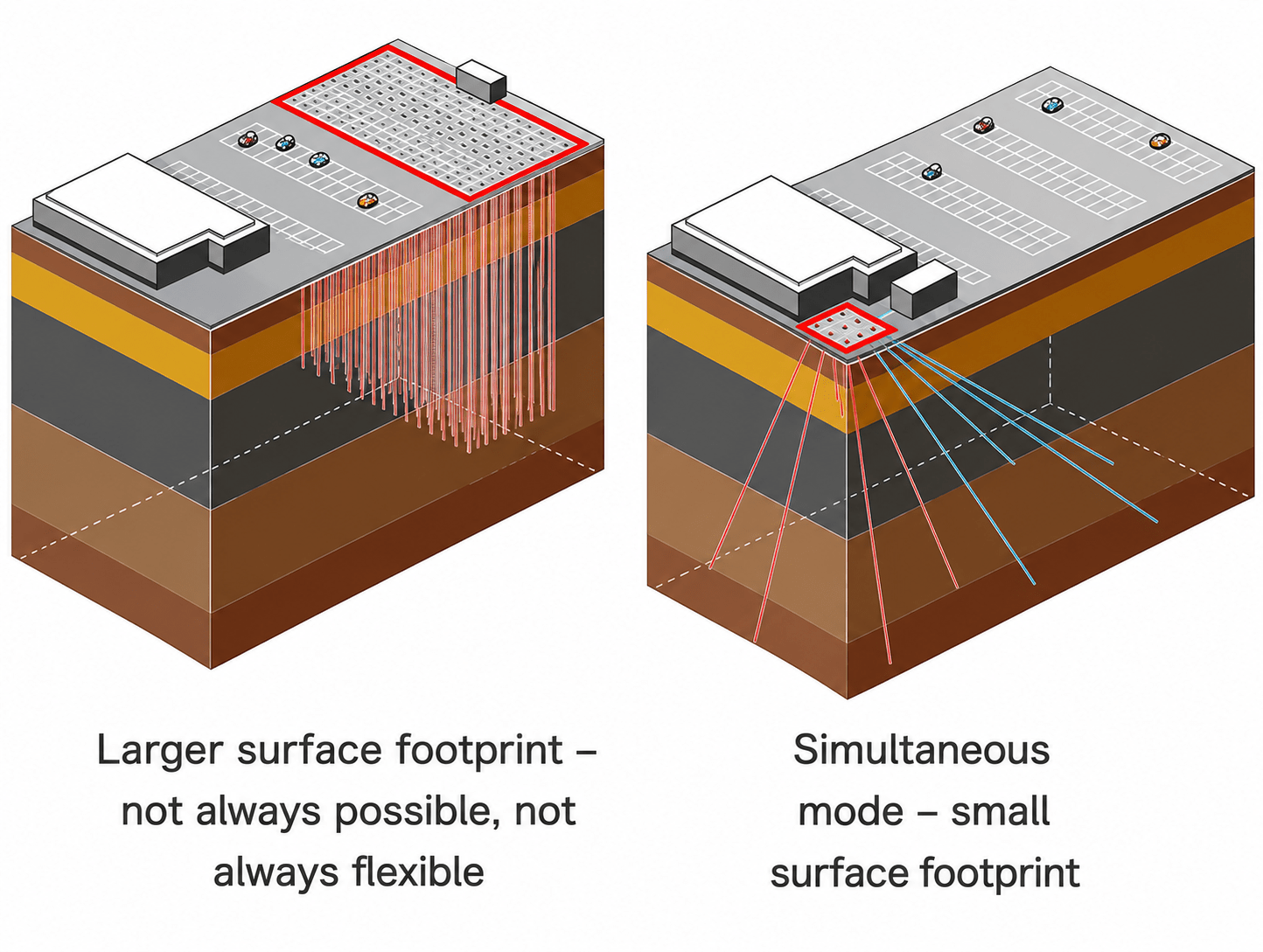
Across the United States, hundreds of commercial buildings, hospitals, universities and communities are heated and cooled using geothermal borehole fields. Most of these systems rely on large arrays of conventional vertical “U-tube” boreholes, often numbering in the hundreds or thousands and require hundreds of miles of pipe and large surface footprints.
These approaches are well documented in industry guidance and published material by organizations such as the US Department of Energy (DOE).
They work. But they are rarely space-efficient.
Data-Led Design, Built on Operational Evidence
At Erda, system design is informed by more than two decades of operational monitoring and analysis. Our modelling approach is based on:
- Long-term performance data from Erda-operated geothermal systems in the UK
- Continuous monitoring of borehole temperatures, thermal loads and seasonal recovery
- Comparative analysis against conventional borehole field designs (Erda | deep)
- Over 200 years of combined operational runtime across live projects
This evidence base allows us to move beyond conservative assumptions and design systems around how geothermal infrastructure actually performs over time.
How Directional Boreholes Change the Equation
Traditional geothermal systems typically rely on vertically drilled U-tube boreholes spaced across large surface areas. These layouts are driven by drilling constraints and simplified thermal modelling assumptions.
Erda’s approach combines:
- Directional and diagonal drilling techniques
- Deep coaxial Erda | deep construction
- Site-specific thermal response testing
- Long-term performance calibration
This methodology is informed by both field data and established thermal modelling frameworks commonly used in the industry, including those referenced in ASHRAE design standards.
By concentrating heat exchange where it is most effective, directional boreholes reduce thermal interference and improve energy density per square foot.
A Real-World Comparison
A large US hospital project currently under construction (publicly documented through planning submissions and contractor disclosures) illustrates the difference between conventional and optimised design approaches.
- Conventional design (public project data)
- ~1,700 vertical boreholes
- ~2,600 miles of pipe
- ~26 acres of surface area
- ~29 billion BTU annual load
- Equivalent Erda model (based on internal performance datasets and calibrated simulations)
- ~170 directional boreholes
- ~450 miles of pipe
- <1 acre footprint
- Equivalent thermal output
The Erda scenario is derived from internally validated modelling, benchmarked against long-term performance data from operating systems and verified thermal response testing.
Why Smaller Systems Perform Better
Reducing system scale is not simply about saving space. Performance data shows that compact, optimized systems can deliver:
- Lower capital expenditure through reduced drilling and materials
- Improved thermal stability through controlled Erda | deep interaction
- Reduced installation risk and programme delays
- Easier long-term monitoring and maintenance
- Greater adaptability for future system upgrades
Many oversized geothermal fields result from limited access to operational data and reliance on generic design assumptions. When real performance data is available, more efficient configurations become viable.
Designing for Performance, Not Just Capacity
Successful geothermal systems are defined by decades of reliable operation, not by the number of boreholes installed.
By combining:
- Long-term operational datasets
- Directional drilling expertise
- Advanced Erda | deep engineering
- Continuous performance monitoring
Erda designs systems around measured outcomes rather than theoretical capacity.
If space is a problem on your site, get in touch at Erdaenergy.com